
Musée d'Orsay 2026
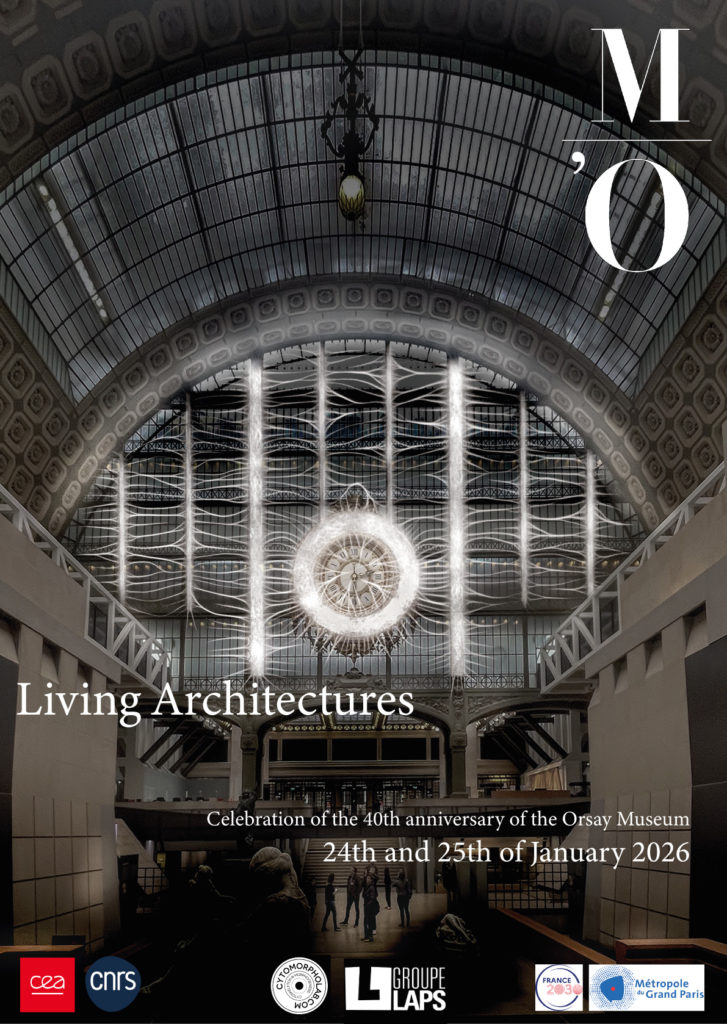
To mark the 40th anniversary of the Musée d’Orsay, the CytoMorpho
laboratory was invited to create a performance based on a series of experiments conducted for the occasion.
For this edition of “Living Architectures”, the chosen scenario discusses cell morphology and how cells adapt their shape to their environment. In addition to shape, it emphasizes the internal architecture of cells, which also adapts to the environment. It highlights that what is alive is not the cell itself, but the interaction between the cell and its environment. It is this coupling that has allowed life to persist for billions of years.
The scenario emphasizes that living organisms are constantly renewing themselves and that it is thanks to this characteristic that they are able to adapt. Not only do their cells get replaced, but the internal components of the cells are also continuously renewed. The internal architecture of cells consists of small filaments. These filaments are interconnected and form large networks. Some filaments assemble, others disassemble. Some replace others, and gradually the entire network renews itself while maintaining its structure. Thanks to this dynamic, the network can grow on one side or contract on another, thereby changing the shape of the cell. Images from the experiments suggest that for a cell, the time that matters is not the second or the minute, but the time it takes to renew itself. It defines the intrinsic timescale at which the cell can sense and adapt to its environment.
Finally, the scenario explores the limits of the plasticity of living organisms. The performance first illustrates the process by which cells change shape and reorganize their filament networks, revealing a remarkable coherence between the interior and exterior of the cell, and between the structure of its filament network and the architecture of the museum. The filaments change orientation depending on the arrangement of the beams or the spacing of the museum’s stones. This impressive plasticity raises the question of the limits of this process. The latest experiments push the cells to their limits. To what extent can the cell construct itself in the image of the museum? Are certain shapes impossible? Are certain sizes beyond reach? Can the cell cover the entire museum?
Conception : Manuel Théry
Réalisation : Léa Blanc, Louise Bonnemay, Simona Buracco, Alice Cantat, Alexandra Colin, Jérémie Gaillard, Christophe Guérin, Laetitia Kurzawa, Nevena Morel, Anne-Betty N’Diaye, Elisa Paulin, Alfredo Sciortino, Flora Silberzan, Bhagyanath Suresh, Clothilde Utzschneider, Benoit Vianay, Laurent Blanchoin & Manuel Théry for the CytoMorpho Lab.
Nadir Bouassria and Pierre Froment for the group LAPS
Video directed by the lab about the project (17 minutes):
Note that the video can be in english or in french. Click on the bottom right to choose your langage.
Video in french by the CNRS about the project (8 minutes):